Watts and Yields: Confronting the Electricity Crisis at the Heart of Vertical Farming
The Promise and the Power Bill
Vertical farming has earned considerable attention as a compelling answer to some of agriculture's most persistent challenges—water scarcity, arable land loss, and supply chain fragility. By stacking crop layers inside climate-controlled warehouses, operators can produce leafy greens, herbs, and specialty crops with a fraction of the water required by conventional field agriculture, regardless of season or geography. In states like Arizona and Nevada, where drought conditions regularly threaten outdoor yields, the appeal is self-evident.
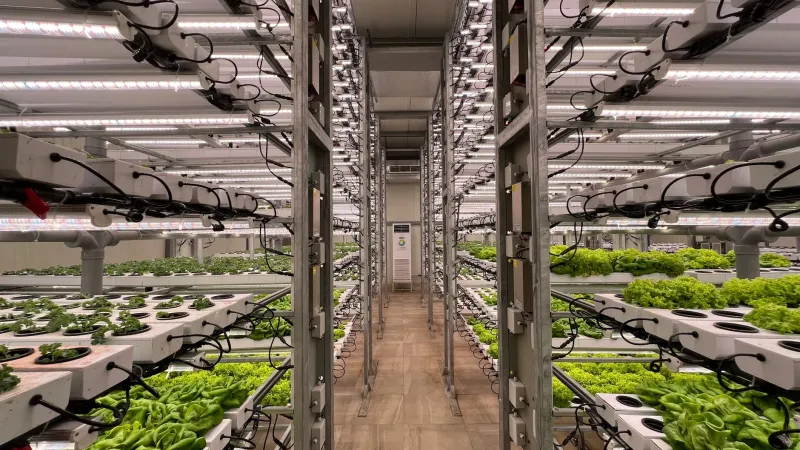
Yet for all its agronomic advantages, indoor farming carries an engineering liability that its proponents have sometimes been slow to acknowledge openly: it consumes extraordinary quantities of electricity. Unlike a greenhouse that supplements natural sunlight, a fully enclosed vertical farm must generate every photon its crops receive. Add climate control, humidity regulation, nutrient delivery systems, and the growing suite of automation technologies, and the result is an operation whose energy footprint rivals that of a small industrial facility.
According to estimates from the American Council for an Energy-Efficient Economy, lighting alone can account for as much as 60 to 70 percent of a vertical farm's total energy expenditure. For an industry still working to demonstrate consistent profitability, that figure is not a footnote—it is a defining constraint.
Why the Lighting Load Is So Demanding
Plants are, in a fundamental sense, light-conversion machines. Photosynthesis requires specific wavelengths—primarily in the red and blue portions of the visible spectrum—delivered at sufficient intensity and duration to drive meaningful biomass accumulation. Replicating this indoors, across thousands of square feet of growing canopy, demands a lighting infrastructure of considerable scale.
LED technology has made this more tractable than it once was. Compared to the high-pressure sodium lamps that dominated indoor horticulture a decade ago, modern horticultural LEDs deliver substantially greater photon output per watt of electricity consumed. Companies such as Fluence, a subsidiary of Signify, and California-based Apogee Instruments have invested heavily in refining spectral tuning—the ability to adjust the precise wavelengths emitted by a fixture to match the physiological requirements of a given crop at a given growth stage.
Despite these advances, the sheer acreage of light surface required in a commercial vertical farm means that even highly efficient fixtures aggregate into a massive collective load. A mid-sized operation producing several thousand pounds of produce per week may operate tens of thousands of individual fixtures simultaneously, often around the clock.
Climate Control as a Secondary Burden
Lighting does not merely consume electricity—it also generates heat, and that heat must be managed. In a sealed growing environment, thermal accumulation is not a passive inconvenience; it is an active threat to crop quality and consistency. Excess heat stresses plants, accelerates transpiration, and can compromise the tightly controlled vapor pressure deficit that operators maintain to optimize growth rates.
Mechanical cooling systems—chillers, air handlers, and dehumidifiers—therefore run in continuous dialogue with the lighting infrastructure, consuming additional power to counteract the thermal byproduct of the very systems driving photosynthesis. This coupling between lighting load and cooling load creates a compounding effect that makes energy efficiency improvements in one domain partially self-defeating if the other is neglected.
Some engineering teams have begun approaching this relationship more holistically. Rather than treating lighting and climate control as separate systems to be optimized independently, forward-thinking operators are designing integrated thermal architectures in which waste heat from lighting fixtures is captured, redirected, and in some cases repurposed—either for space heating in cooler climates or for driving absorption chillers that convert thermal energy back into cooling capacity.
Waste Heat Recovery and the Circular Energy Model
The concept of waste heat recovery is well established in industrial engineering but has only recently gained traction in controlled-environment agriculture. Vertical farms operating in northern states such as Michigan, Minnesota, and Maine have begun piloting systems that route warm air from lighting arrays through heat exchangers, capturing thermal energy that would otherwise be expelled by HVAC systems at additional electrical cost.
In some configurations, this recovered heat is transferred to anaerobic digestion systems or aquaponic water loops, where consistent warmth accelerates biological processes and reduces supplemental heating requirements. Startups including Fifth Season—before its closure prompted a broader industry reassessment—and more durable operators like AppHarvest and Little Leaf Farms have each explored variations of this approach, though implementation details vary considerably by facility design and geographic context.
The underlying principle is straightforward: every watt that enters a vertical farm as electricity ultimately becomes heat. The question is whether that thermal energy dissipates as waste or is captured and redirected toward productive ends. Engineering teams that treat their facilities as closed thermal systems rather than open ones stand to recover a meaningful fraction of their operating costs.
Renewable Integration: Structural and Economic Realities
Reducing the carbon footprint of vertical farming—and, critically, its electricity cost—has prompted many operators to explore on-site renewable generation. Rooftop photovoltaic arrays represent the most straightforward option, though the economics are complicated by a structural irony: vertical farms, by design, minimize their footprint relative to their productive volume, which limits the roof area available for solar panels relative to the electricity demand contained beneath.
Some developers have addressed this by co-locating vertical farms with larger renewable installations, either through direct ownership or through power purchase agreements with utility-scale solar and wind projects. In Texas, where deregulated electricity markets allow commercial buyers to contract directly with renewable generators, several indoor farming operations have structured long-term agreements that both reduce per-kilowatt-hour costs and provide a degree of price stability absent from spot markets.
Battery storage systems add another layer of complexity and capital expenditure but offer the ability to shift consumption toward off-peak hours when grid electricity is cheaper and, in renewable-heavy markets, cleaner. As battery costs continue to decline and grid operators in states like California increasingly incentivize demand flexibility, this approach is becoming more financially viable for large-scale operations.
The Path Toward Energetic Viability
The vertical farming industry is at an inflection point. A wave of high-profile closures and financial restructurings over the past two years—including the bankruptcy proceedings of AeroFarms and the operational wind-down of AppHarvest—has forced a more rigorous examination of unit economics across the sector. Energy cost, long treated as a variable to be managed incrementally, is now recognized as a structural determinant of whether indoor farming can achieve the scale its advocates envision.
The engineering responses emerging from this pressure are substantive. Advances in photon efficacy continue to push LED performance closer to theoretical limits. Spectral research is yielding lighting protocols that reduce photoperiod requirements without sacrificing yield. Thermal integration designs are maturing from pilot experiments into repeatable engineering standards. And the falling cost of utility-scale renewables is gradually making clean power a more accessible input for operations willing to make long-term infrastructure commitments.
None of these developments, taken individually, resolves the energy challenge. But collectively, they represent a credible engineering trajectory toward operations that are not merely productive but genuinely sustainable—in both the environmental and the financial sense. For an industry that has sometimes allowed its agronomic ambitions to outpace its operational discipline, that convergence cannot arrive soon enough.