Controlled Skies, Real Yields: The Engineering Case for Indoor Agriculture at Scale
A Growing Argument, Literally
The pitch for vertical farming sounds almost utopian: leafy greens growing in climate-controlled towers, untouched by drought, pesticide drift, or seasonal constraint. Racks of LED-lit crops stacked floor to ceiling, tended by robotic arms and managed by artificial intelligence—all within a converted warehouse in Newark, New Jersey or suburban Phoenix, Arizona. The promise is compelling. The execution, however, is considerably more complicated.
Controlled-environment agriculture (CEA) has attracted billions in venture capital over the past decade, spawning operations from AeroFarms in New Jersey to AppHarvest's greenhouse complexes in Kentucky. Yet the industry has also witnessed high-profile collapses, with AppHarvest filing for bankruptcy in 2023 and AeroFarms undergoing restructuring. These setbacks have not killed the concept—they have, arguably, clarified what it will take for indoor agriculture to mature into a reliable component of the American food system.
What the Technology Actually Delivers
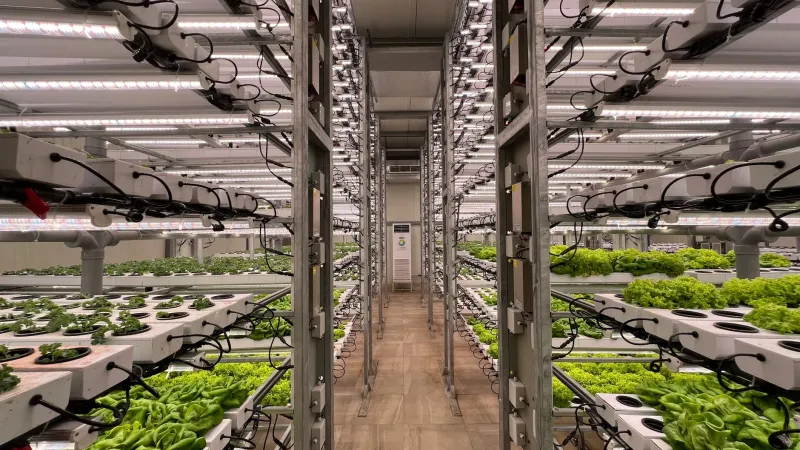
At its core, vertical farming replaces sunlight with tunable LED arrays, soil with hydroponic or aeroponic nutrient solutions, and weather with algorithmic climate control. The engineering advantages are real. Water usage in a well-designed hydroponic system can be reduced by as much as 95 percent compared to conventional field irrigation—a figure that carries enormous weight in drought-stressed regions like California's Central Valley or the Colorado River basin.
Yields per square foot also improve dramatically. Lettuce, herbs, and microgreens—the current commercial sweet spot—can be harvested in cycles as short as 21 days, with multiple harvests per year compressed into a single vertical footprint. Bowery Farming, which operates facilities in Maryland and New Jersey, reports yield densities more than 100 times greater than comparable outdoor acreage.
Sensor arrays continuously monitor temperature, humidity, CO₂ concentration, and nutrient levels, feeding data into machine learning models that optimize growing conditions in real time. This is precision agriculture in its most literal form: every variable engineered, every output measured.
The Energy Equation Nobody Can Ignore
Here is where the engineering narrative encounters its most significant friction. Artificial lighting is energy-intensive. According to a 2021 analysis published in the journal Nature Food, indoor lettuce production generates approximately 3.5 kilograms of CO₂ per kilogram of product—compared to roughly 0.4 kilograms for field-grown lettuce. That gap narrows considerably when facilities are powered by renewable energy, but most commercial operations in the United States are not yet operating on fully green grids.
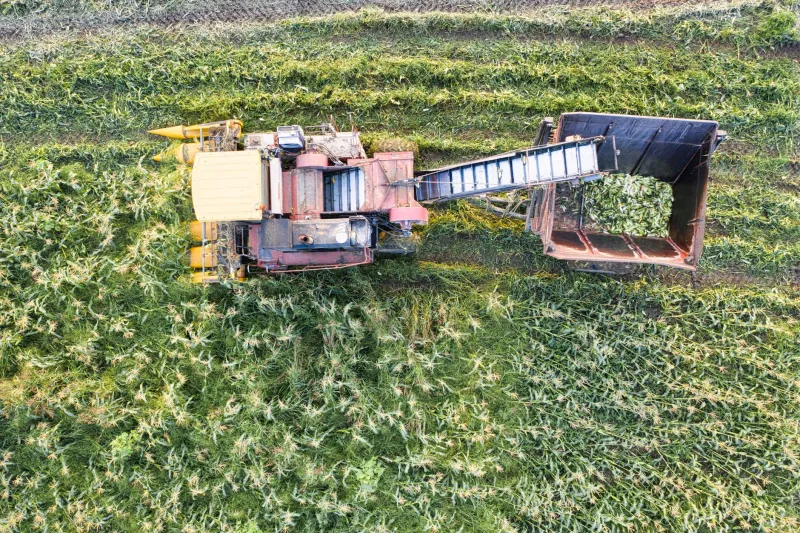
Energy costs can represent 25 to 35 percent of total operating expenses in a vertical farm, a burden that squeezes margins on crops already sold at premium price points. The economic model works for high-value, fast-cycling produce consumed close to the facility. It struggles—at present—for staple crops like wheat, corn, or soybeans, which require extensive acreage and far more light energy per calorie produced.
This is not a fatal limitation, but it is a defining one. Vertical farming, as currently engineered, is not a wholesale replacement for open-field agriculture. It is a targeted supplement.
Automation as the Load-Bearing Wall
The facilities that have demonstrated the most operational resilience share a common trait: deep investment in automation. Labor is the second-largest cost driver in indoor agriculture, and the farms navigating toward profitability are those that have reduced human touchpoints through robotics and intelligent software.
IronOx, a California-based company, has built a system in which autonomous robots move plant trays through growth stages, with computer vision systems monitoring individual plant health. The company's model reduces per-unit labor costs significantly while maintaining consistent quality. Similarly, Plenty—backed by SoftBank and Walmart—has engineered facilities where robotic systems handle seeding, transplanting, and harvesting with minimal human intervention.
The automation roadmap matters because it determines whether vertical farms can achieve the throughput necessary to compete on price with conventionally grown produce. As robotics costs decline and software capabilities improve, the economic threshold for profitability shifts downward.
Case Studies: What Operational Success Looks Like
Gotham Greens, founded in 2009 and now operating rooftop and ground-level greenhouses across multiple US states, represents one of the more durable business models in the CEA sector. Rather than pursuing the maximum-stack vertical approach, the company focuses on greenhouse production—capturing natural sunlight and supplementing with artificial lighting only as needed. This hybrid approach materially reduces energy overhead while maintaining the climate-control advantages of indoor production.
Little Leaf Farms in Massachusetts takes a similar greenhouse-first philosophy, focusing exclusively on butter lettuce and achieving price points competitive with field-grown alternatives in New England markets. The company's regional distribution model eliminates the cold-chain losses that erode margins on perishable produce shipped from California or Arizona.
These examples suggest that the most viable near-term path for indoor agriculture is not one-size-fits-all vertical stacking, but rather geographically targeted facilities growing high-value crops for regional markets.
The Decade Ahead: Realistic Expectations
Industry analysts at Mordor Intelligence project the US vertical farming market will grow at a compound annual rate exceeding 20 percent through 2030—significant expansion, but from a relatively modest base. The consensus among agricultural engineers and economists is that indoor agriculture will capture a meaningful share of the fresh produce market, particularly leafy greens, herbs, and select fruiting vegetables, while open-field production continues to dominate calorie-dense staple crops.
Technological progress in LED efficiency, battery storage for renewable integration, and AI-driven crop optimization will gradually improve the energy economics of indoor production. But the transformation will be incremental, not revolutionary.
For America's food system, that may be precisely the right expectation to hold. Vertical farming is not a silver bullet. It is an engineering tool—one with genuine capabilities and genuine constraints—that, deployed strategically, can strengthen the resilience and geographic reach of domestic food production. The farms that understand that distinction are the ones most likely to still be operating when the next decade's harvest arrives.