Dual Harvest, Single Field: Designing Agrivoltaics So Crops and Kilowatts Both Pay
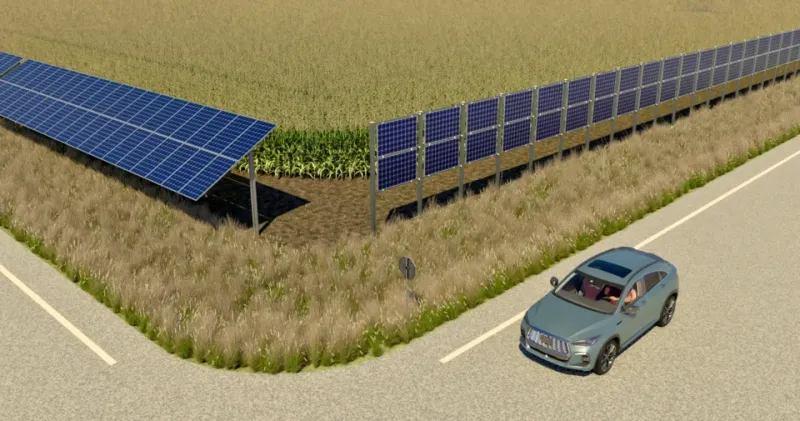
Photo: Wikideas1, CC0, via Wikimedia Commons
Agrivoltaics has moved from demonstration plots to serious project pipelines across the United States. As of November 2026, developers, utilities, and farmland owners are evaluating dual-use solar designs with greater discipline than the early pilot projects allowed. The pitch is straightforward: a field can produce electricity and agricultural value at the same time. The engineering reality is that a dual-use field is a system, and every design choice that improves one output tends to impose a cost on the other.
That trade-off is not a reason to dismiss agrivoltaics. It is the reason to design it carefully. The projects that pencil out for US farmers will be those that treat panel geometry, crop physiology, interconnection, and long-term land management as one integrated problem rather than as separate line items.
The Geometry Is the Agronomy
Panel height and row spacing are the first engineering decisions, and they are also agronomic decisions. A low fixed-tilt array may be cheaper to build, but it limits machinery access, reduces light uniformity, and can make the field impractical for conventional row-crop equipment. Higher racks and wider rows improve light distribution and equipment clearance, but they increase steel, foundation, and installation costs per kilowatt.
Tracking systems add another variable. A tracker that follows the sun can shift shade across the field during the day rather than concentrating it in one strip. In some designs, that movement can reduce chronic shade stress on crops. In others, it can complicate irrigation patterns and make crop management less predictable. Bifacial modules add reflected light to the calculation, but the benefit depends on ground cover, albedo, and panel height.
The practical question is not whether a design looks elegant in a rendering. It is whether the field can support the equipment, labor, and crop calendar that the farmer actually uses. A solar layout that blocks a combine or sprayer is not a dual-use system, regardless of what the lease says.
Crop Selection Is a Constraint, Not a Slogan
Corn is a difficult first candidate for agrivoltaics in most US designs. It is a high-light crop with narrow tolerance for shade, and its yield sensitivity can erase the value of the solar lease. The same is true for many high-value row crops that depend on full-sun conditions. Projects that promise corn and kilowatts without a serious yield analysis are selling a story, not an engineering plan.
More credible candidates include shade-tolerant leafy greens, forage and pasture systems, small grains, berries, pollinator habitat, and managed grazing. These systems can tolerate partial shade or benefit from the microclimate that panels create. Panels can reduce wind speed, lower soil evaporation, and moderate temperature extremes. Those effects may help in hot, dry regions and may create problems in cool, humid ones where reduced airflow encourages disease.
Microclimate is highly site-specific. Soil type, rainfall, humidity, wind direction, and crop canopy all interact with the array. A design that works in Arizona is not automatically transferable to Illinois or Pennsylvania. Developers need site-level monitoring and clear performance metrics, not generic crop lists.
Interconnection and the Economics of Two Products
The solar side of an agrivoltaic project faces the same grid realities as any utility-scale array. Interconnection queues can be long, upgrade costs can be high, and the value of exported electricity depends on local tariffs, net billing rules, and power purchase agreements. A project that looks attractive on land productivity alone may fail at the interconnection study.
Landowner economics must also be modeled honestly. A lease payment is not the same as net farm income. Farmers need to compare the solar lease against the crop enterprise they are giving up, including the cost of altered field operations. Insurance, property taxes, vegetation management, panel cleaning, and decommissioning obligations all affect the long-term balance sheet. Some projects work best as landowner leases; others may justify farmer ownership or co-investment. The right structure depends on risk tolerance and access to capital.
Grid interconnection is often the binding constraint, not panel efficiency. Developers who treat the utility study as an afterthought tend to discover that the most efficient array is the one that can actually connect.
Designing for the Fifth Year, Not the First
Agrivoltaic projects are often sold on first-year renderings. The harder test is the fifth year, when vegetation management costs have stabilized, equipment has aged, and the crop rotation has met real weather. Designers should plan for machinery access, drainage, dust, hail, and maintenance. They should specify who controls vegetation under and around the array and how panel cleaning will affect soil and crops.
Monitoring matters as well. A dual-use site should collect data on light levels, soil moisture, crop yield, and energy production so that both sides of the system can be evaluated. Without that data, the industry will keep arguing from anecdotes.
Agrivoltaics can be a credible tool for US farmland, particularly where land values are high, grid demand is strong, and crop systems are flexible. But it is not simply panels plus plants. The model pencils out only when the engineering respects the agronomy, the interconnection respects the grid, and the contract respects the farmer.
Agineer's view is that the next phase of agrivoltaics should be judged less on installed megawatts and more on measured dual-use performance. A field that produces watts while degrading the farm operation is not a dual harvest. It is a single harvest with extra steps.