The Invisible Infrastructure Gap Wasting One-Third of America's Harvest
Building a satellite requires solving problems that have never been solved before. The physics are unforgiving, the tolerances are measured in microns, and failure means losing a machine that cost hundreds of millions of dollars to a vacuum no one can reach. It is, by almost any measure, one of the most demanding engineering challenges humans attempt.
Building a functional cold chain for American produce is harder.
Not harder in the sense of requiring more sophisticated mathematics or more exotic materials. Harder in the sense that it requires coordinating thousands of independent actors—farmers, truckers, distributors, retailers, and consumers—across a geography of three million square miles, under economic conditions that frequently make the right infrastructure investment the least attractive financial option. A satellite has one owner and one mission. A cold chain has no owner and several competing ones.
The consequences of this coordination failure are staggering. The USDA estimates that between 30 and 40 percent of the US food supply is wasted, with a substantial share of those losses occurring between harvest and retail. For fresh fruits and vegetables—the categories most sensitive to temperature and handling—postharvest losses can exceed 50 percent in some supply chains. This is not a rounding error. It represents an enormous volume of water, land, labor, and energy inputs that generated food no one ever ate.
Where the Food Actually Disappears
Public discussion of food waste tends to focus on the consumer end of the supply chain—the wilted lettuce at the back of the refrigerator, the forgotten leftovers. Consumer waste is real and worth addressing. But the structural losses embedded in postharvest logistics are larger, less visible, and more amenable to engineering intervention.
The problem begins at the farm gate. Many small and mid-sized American operations lack adequate on-farm cooling infrastructure. Fresh produce respiration—the biological process that continues after harvest—generates heat and accelerates ripening. Every hour between harvest and pre-cooling represents irreversible quality degradation. For high-value crops like strawberries, leafy greens, and stone fruit, the window between harvest and the onset of significant quality loss can be measured in hours.
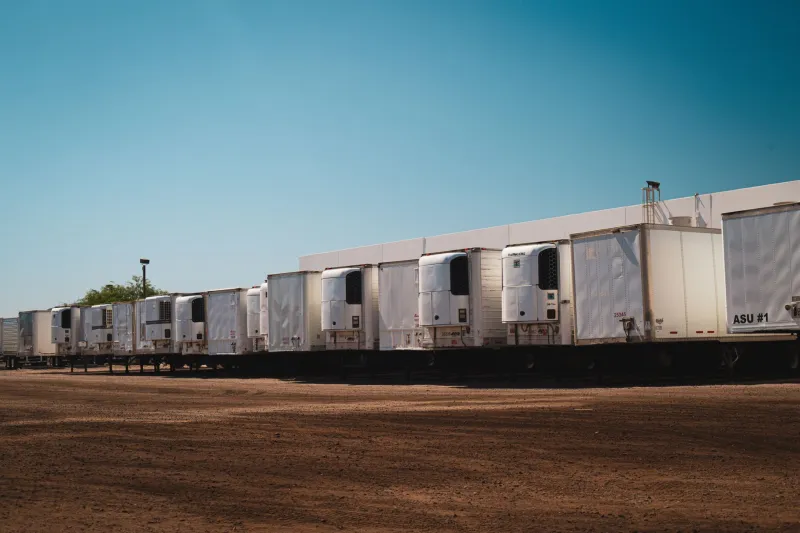
From the farm, product enters a distribution system that is frequently less temperature-controlled than it appears. Refrigerated trucks are common, but door openings during loading and unloading expose product to ambient temperatures. Transition points between cold storage facilities and transport vehicles—sometimes called the "cold chain gap"—are poorly monitored in most supply chains. Temperature loggers, where they exist, often record aggregate data rather than continuous readings, making it difficult to identify exactly where a thermal excursion occurred.
By the time product reaches a distribution center or retail location, cumulative temperature abuse may have already reduced shelf life significantly—without any visible indication on the product itself. Retailers and consumers have no reliable way to know that a carton of berries spent four hours at 60 degrees Fahrenheit during a loading dock transfer three days ago.
The Technology Shelf Is Stocked; the Adoption Is Not
The engineering community has not been idle. A range of technologies capable of meaningfully reducing postharvest losses is commercially available today.
Time-temperature indicator labels—small adhesive sensors that change color in response to cumulative thermal exposure—have existed for decades. They are inexpensive, require no power, and can provide a visible indication of whether product has been adequately refrigerated throughout its journey. Their adoption in US fresh produce supply chains remains limited, largely because they add a small per-unit cost that no single supply chain participant is eager to absorb.
More sophisticated smart packaging systems embed sensors capable of detecting ethylene gas, carbon dioxide concentrations, and microbial activity—all of which provide earlier and more accurate signals of spoilage than visual inspection. Several companies are developing packaging that actively responds to these signals, releasing antimicrobial compounds or modified atmosphere adjustments to extend shelf life. These systems are further from mass-market adoption, but the underlying technology is mature enough to deploy at scale in premium supply chains today.
On the infrastructure side, modular and pre-fabricated cold storage units have emerged as a potential solution for the on-farm cooling gap. Unlike traditional cold storage construction, which requires significant capital and permanent installation, modular units can be deployed rapidly, relocated as needed, and financed through lease arrangements that reduce upfront costs. Several startups are targeting smallholder and mid-scale operations in the US with products in this category, though market penetration remains low.
Predictive spoilage modeling—using machine learning to integrate temperature history, transit time, product variety, and ambient conditions into a real-time estimate of remaining shelf life—represents perhaps the most commercially interesting near-term opportunity. If a retailer or distributor could accurately predict which pallets of product are approaching the end of viable shelf life, they could reprice, reroute, or process those items before they become waste rather than after. The data inputs for such models are increasingly available; the integration into operational logistics systems is the remaining challenge.
Why Capital Keeps Looking Elsewhere
Given the scale of the problem and the availability of relevant technology, the question of why postharvest loss remains so persistent deserves a direct answer. The answer is largely structural.
Venture capital in agtech has historically concentrated on technologies with high intellectual property content, defensible competitive moats, and the potential for rapid scaling across large addressable markets. Seed genetics, AI-driven crop management platforms, and novel protein production fit this profile. Cold chain infrastructure, smart packaging, and logistics optimization are less obviously venture-scalable. They tend to require physical assets, involve thin margins, and compete against entrenched incumbents in industries—refrigerated transport, packaging manufacturing—that are not known for rapid technology adoption.
The businesses best positioned to deploy cold chain solutions at scale are often large food companies and retailers with the procurement leverage to mandate supply chain standards. When Walmart or Kroger requires temperature logging across their fresh produce supply chains, adoption follows quickly. That kind of buyer-driven pressure has been the primary driver of cold chain improvement in recent decades—not startup innovation.
Public investment has also played a role. USDA grants and Rural Development programs have funded on-farm cold storage infrastructure in underserved regions, with measurable impact on postharvest loss rates for participating operations. Expanding these programs, and connecting them to the monitoring and analytics tools that make cold storage most effective, represents a straightforward policy lever that receives less attention than it merits.
The Return on Unglamorous Engineering
There is a version of this story that ends with a breakthrough: a new packaging material that eliminates spoilage, or an AI system that perfectly orchestrates the cold chain from harvest to consumer. That version is unlikely.
The more probable path to meaningful postharvest loss reduction runs through incremental improvements across multiple points in the supply chain, driven by a combination of better technology, stronger buyer requirements, targeted public investment, and the slow normalization of cold chain monitoring as a standard operating practice rather than a premium add-on.
None of that is as compelling as a satellite launch. But if the goal is engineering food systems that are more efficient, more resilient, and less wasteful, the cold chain gap is one of the highest-return problems available. The food has already been grown. The energy has already been spent. The only remaining question is whether it reaches someone who can eat it.