The Water Behind the Recommendation: Auditing AI's Hidden Resource Bill in Precision Agriculture
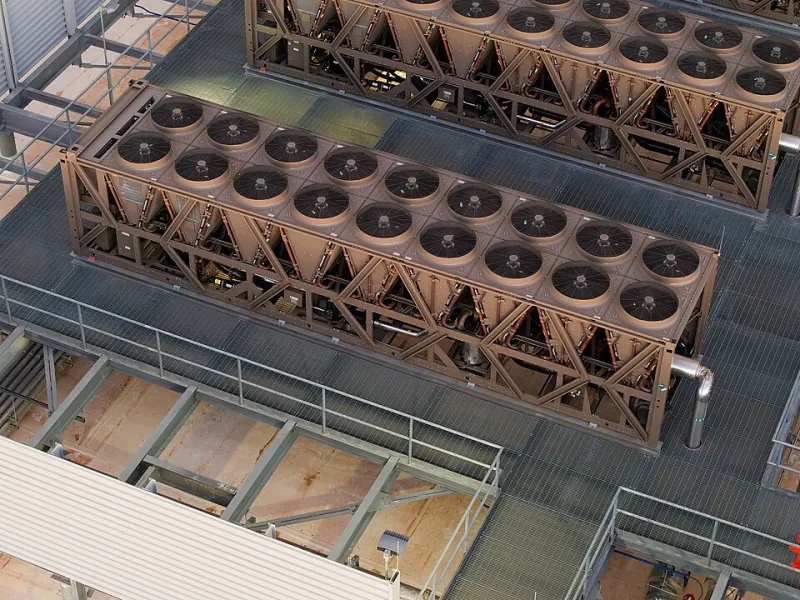
Photo: Rsparks3, CC0, via Wikimedia Commons
A precision irrigation platform sends a farmer a recommendation: irrigate this block tomorrow morning, not tonight. The advice may save water. It may also have been produced by a chain of sensors, cellular links, cloud servers, machine-learning models, and dashboard software that consumed electricity and water far from the field. That hidden resource bill is rarely part of the conversation.
As agricultural AI scales in the United States, the accounting gap matters. Farmers are being asked to trust recommendations that depend on infrastructure they cannot see. Investors are funding platforms that promise sustainability gains. Regulators and water districts are beginning to ask whether digital agriculture is reducing resource use or simply moving it around.
The Recommendation Stack
A typical precision agriculture recommendation is not generated by a single model. It is the output of a stack. Soil moisture sensors and weather stations collect data. Edge gateways clean and buffer it. Cellular or satellite links carry it to the cloud. Data pipelines validate it. Models estimate crop water demand, disease risk, or nitrogen needs. A dashboard presents the result. A farmer acts on it.
Training and inference have different footprints. Training a large model can require significant computing over days or weeks. Inference, the ongoing act of generating recommendations, is often less intensive per request but can scale across millions of acres and seasons. The agricultural AI industry tends to emphasize model accuracy and field outcomes. It rarely publishes water or energy intensity per recommendation.
Water in the Data Center
Data centers consume water mainly for cooling, and the amount varies widely by location, cooling design, and electricity source. Evaporative cooling can be water-intensive. Closed-loop systems can reduce water use but may increase electricity demand. The water embedded in electricity generation adds another layer, particularly in regions where thermoelectric power plants depend on cooling water.
That means the water footprint of an agricultural AI platform depends on where its servers are located and when they operate. A model trained in a water-stressed region has a different profile from one trained in a cooler climate with low-carbon power. Yet most agricultural software contracts do not disclose server location, cooling type, or water intensity. Farmers cannot compare platforms on resource cost because the data is not available.
The Rural Edge Is Not Free
Edge computing is often presented as a sustainability solution because it reduces data transmission and cloud dependence. That is partly true. But edge devices have their own footprint: manufacturing, batteries, solar panels, enclosures, maintenance visits, and eventual electronic waste. In rural areas with unreliable connectivity, edge systems may need backup power and hardened hardware that increase cost and material use.
Edge computing can also shift water and energy accounting to the farm. A solar-powered gateway may be benign in one sense, but it still represents embodied energy and materials. The honest comparison is not cloud versus edge in the abstract. It is the total resource cost of each architecture across its lifecycle.
What Farmers and Engineers Should Count
Agricultural AI needs a common accounting framework. At minimum, platforms should report energy use, water use, and carbon intensity for training and inference, ideally by region and by season. They should disclose whether they use evaporative cooling and where workloads run. They should offer estimates per acre or per recommendation so that farmers can compare the resource cost of the advice against the resource savings it promises.
Engineers can also design for efficiency. Right-size models instead of defaulting to the largest available. Schedule training in regions and seasons with lower water stress. Use federated or edge processing where it genuinely reduces total impact. Cache and reuse predictions. Avoid collecting data that does not improve decisions. These are ordinary software engineering practices, but they become sustainability practices when they are measured.
The Accounting Gap
There is no standard for agricultural AI resource reporting in the US today. Sustainability claims are often based on field-level outcomes, not infrastructure-level costs. That is a problem for farmers, insurers, and investors who want to know whether a platform is actually reducing resource use. It is also a problem for the industry's credibility.
The water behind the recommendation is real. It is not necessarily large compared with irrigation itself, but it is not zero, and it is growing as AI workloads expand. The responsible path is not to reject agricultural AI. It is to count its costs honestly, compare them with its benefits, and design systems that are efficient by intention rather than by accident.
Agineer's view is that precision agriculture should include precision accounting. A recommendation that saves water in the field but ignores water in the data center is only half-engineered. The next generation of agricultural AI should be judged not just by what it recommends, but by what it consumes to recommend it.