When Bees Are Not Enough: Engineering Robotic Pollinators for American Crops
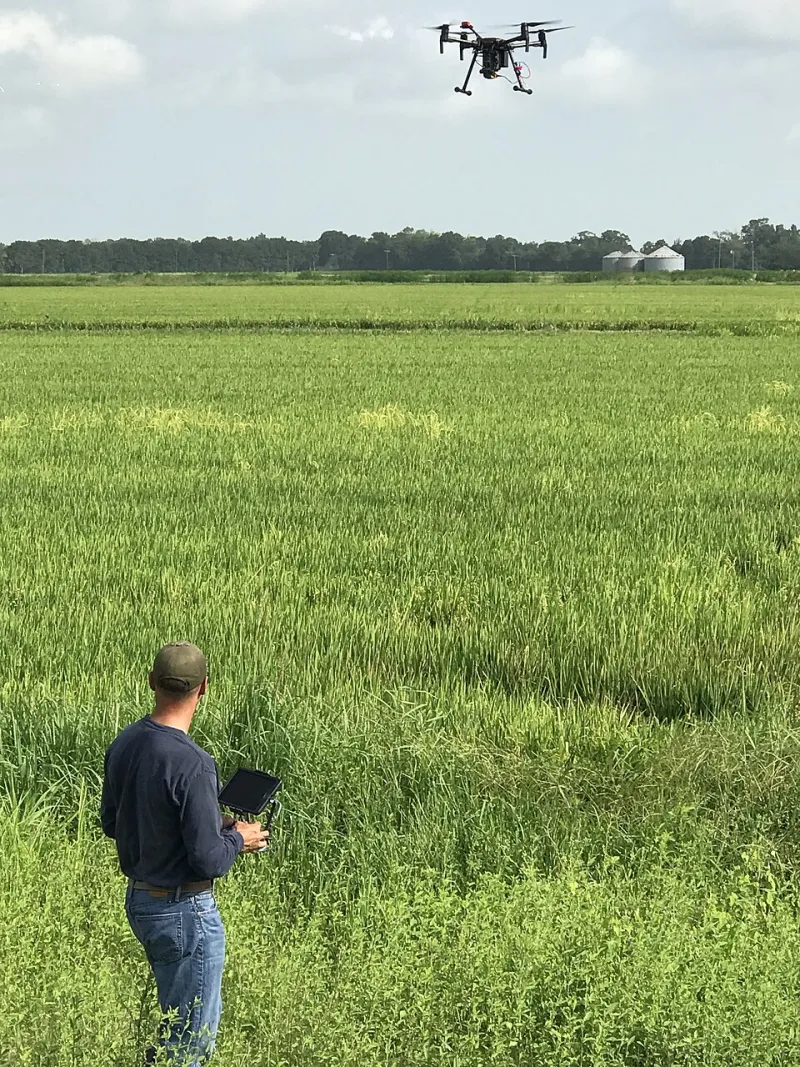
Photo: USDAgov, Public domain, via Wikimedia Commons
The almond orchards of California's Central Valley offer one of the starkest illustrations of American agriculture's dependence on managed pollinators. Each February, more than a million honeybee colonies are trucked from across the country to service roughly a million acres of almond trees — a logistical operation of remarkable scale that underpins a crop valued at more than five billion dollars annually. That dependence has become increasingly precarious. Colony collapse disorder, Varroa mite infestations, pesticide exposure, and habitat loss have collectively reduced managed honeybee populations and driven the cost of hive rental to record levels. Engineers and roboticists are now asking whether technology can provide a meaningful supplement — or, in some scenarios, a partial substitute.
The Scale of the Pollination Problem
The economic stakes are considerable. The USDA estimates that insect pollination contributes to roughly one-third of the American food supply by volume, with a farm-gate value that researchers have placed as high as fifteen billion dollars per year. Almonds, blueberries, cherries, apples, and cucumbers are among the crops most dependent on managed pollination services. As colony availability tightens and hive rental costs rise, growers in states from Washington to Florida are actively seeking alternatives.
The engineering challenge is, in some respects, a biomimicry problem. Honeybees have evolved over millions of years to perform pollination with extraordinary efficiency — locating flowers using ultraviolet vision, collecting and depositing pollen with specialized anatomical structures, and communicating the locations of productive foraging sites through complex behavioral signaling. Replicating even a fraction of this capability in a mechanical system requires integrating advances from robotics, computer vision, materials science, and autonomous navigation.
Computer Vision and Flower Detection
Before a robotic pollinator can deliver pollen, it must reliably identify and locate individual flowers within a complex, visually cluttered agricultural environment. This is fundamentally a computer vision problem, and it is one that recent advances in deep learning have made substantially more tractable.
Convolutional neural networks trained on labeled image datasets can now distinguish flower species, assess bloom stage, and estimate the precise spatial coordinates of individual blossoms with accuracy sufficient for autonomous approach. Research groups at institutions including MIT, Carnegie Mellon, and the University of California system have published results demonstrating reliable flower detection across a range of crop types and lighting conditions. The challenge shifts from detection to actuation once a target is identified — the robot must physically contact the flower's reproductive structures and transfer pollen without damaging the bloom.
Several engineering approaches to the contact problem have emerged. Researchers at Harvard's Wyss Institute demonstrated a gram-scale drone coated with a sticky, hair-like material capable of passively collecting and depositing pollen during flight. Others have pursued active pollen delivery through electrostatic charging, exploiting the fact that flowers generate a weak positive electric field that naturally attracts negatively charged pollen — a mechanism that bees exploit through the static charge their bodies accumulate in flight.
Drone Platforms and Autonomous Navigation
The airframe is as consequential as the sensor payload. Small multirotor drones offer the maneuverability necessary to navigate within orchard canopies and greenhouse corridors, but their flight endurance is constrained by battery energy density — a fundamental physics limitation that has not yielded to engineering ambition as rapidly as the industry once projected. Most current research platforms achieve flight times of fifteen to thirty minutes per charge, which is inadequate for continuous field deployment at commercial scale.
Swarm architectures offer a partial answer to the endurance problem. Rather than relying on a single large drone, a distributed fleet of lightweight autonomous agents can operate in rotation, with units returning to charging stations while others remain active. Coordinating such fleets requires robust inter-agent communication protocols and collision avoidance algorithms capable of functioning in GPS-degraded environments such as dense orchard interiors. Companies including Arugga AI Farming, which has piloted systems in tomato greenhouses, and Israeli startup Edete Precision Technologies, which has conducted almond orchard trials in California, are among the organizations pursuing field-deployable platforms.
Ground-based robotic systems represent an alternative architecture that sidesteps the endurance constraints of aerial platforms. A wheeled or tracked robot moving through row crops can carry substantially larger power reserves and sensor payloads than a flying counterpart, though it is limited to crops where flowers are accessible from below the canopy or along accessible rows.
Economic Feasibility and Field Realities
The engineering accomplishments in robotic pollination research are genuine, but a candid assessment of commercial feasibility requires acknowledging the gap between laboratory demonstrations and field deployment at agricultural scale. A single almond orchard may contain hundreds of thousands of individual flowers requiring pollination within a narrow window of a few weeks. Achieving pollination coverage comparable to that provided by managed bee colonies — which can number in the tens of thousands of foragers per hive — with robotic systems that currently operate as individual units or small fleets remains a formidable scaling challenge.
Cost is the other governing constraint. A managed honeybee hive rents for approximately two hundred to two hundred and fifty dollars per season in high-demand markets. A robotic pollination system capable of matching the coverage of a single hive would need to operate at a comparable or lower cost per acre to be economically attractive to growers already operating on thin margins. That threshold has not yet been reached, though proponents argue that the cost trajectory of robotics and computer vision hardware is strongly downward.
A Complement, Not a Replacement
The most technically grounded perspective positions robotic pollination not as a wholesale replacement for natural pollinators, but as a targeted supplement for high-value specialty crops in environments where conventional pollination services are unavailable, unreliable, or prohibitively expensive. Controlled-environment agriculture — the greenhouse and vertical farm sector — presents the most immediate commercial opportunity, as the enclosed, structured environment simplifies navigation, reduces weather variability, and allows for more predictable engineering specifications.
For open-field crops, the engineering roadmap remains longer. Sustained progress in battery energy density, swarm coordination algorithms, and low-cost manufacturing will all be necessary before robotic pollinators can operate at the spatial and temporal scales that American agriculture demands. In the interim, the most productive engineering investment may be in systems that help growers monitor pollination coverage and identify gaps — using the same computer vision and drone platforms being developed for autonomous pollination — so that managed bee colonies can be deployed with greater precision and efficiency.